In my work with young people, I often return to a simple question: Who is this work really for?
It’s easy to say that creative projects are “for” children and young people - designed to engage, inspire or educate. But increasingly, I’ve found that the most meaningful work happens when that relationship shifts. When young people are not just the audience, but collaborators within the process.
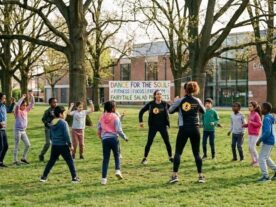
Through my work with Waggle Dance Co., particularly in primary schools across Enfield, I design immersive and participatory experiences where children are invited to step inside the work. They take on roles, make decisions, and shape the direction of what unfolds. The structure is there — carefully planned, curriculum-linked, and held with intention — but within it, there is space for unpredictability.
This is where co-creation begins.
In practice, co-creation isn’t always neat. It requires a balance between guidance and openness. As a facilitator, I am still responsible for holding the space, managing time, and ensuring the experience is meaningful and safe. But I am not responsible for every outcome. Some of the most powerful moments come from ideas I didn’t plan — a child reframing a narrative, asking an unexpected question, or offering a solution that shifts the direction of the session. I think the young people’s ideas are WAY more fun and exciting than what I may have come up with initially.
Letting go of control, even slightly, creates room for ownership and for children’s self-agency.
I’ve seen how this changes the dynamic in the room. When young people recognise their ideas within the work, their engagement deepens. They listen differently. They take risks. They invest not because they’ve been asked to, but because they feel part of something being built in real time. It is made by them!
This approach also allows for a wider range of voices to be heard. Not every child will want to perform or speak out, but co-creation can take many forms — movement, drawing, small group discussion, quiet decision-making. Creating multiple ways to contribute means more young people can see themselves reflected in the process which I feel is vital to the project.
Working in this way has also shaped how I think about my role as an artist. Rather than arriving as the expert with a finished idea, I arrive with a framework — something flexible enough to respond to the participants in the room. The work becomes something we build together, rather than something I deliver.
Of course, this sits within real constraints. Schools have time limits. Projects have outcomes. There are always practical considerations to hold alongside the creative process. But I’ve found that co-creation doesn’t require abandoning structure — it simply asks for a shift in how that structure is used.
For me, making work with young people is about creating the conditions for something shared to emerge. It’s about listening as much as leading, and recognising that creativity doesn’t belong to one person in the room.
When that shift happens — even in small ways — the work becomes more alive, more relevant, and more memorable for everyone involved.
Looking forward to new workshops in the pipeline this year!
Fingers crossed we’ll see you on the Dancefloor! Thanks for reading.
Jess Birks, Founder of Waggle Dance Co.